Maven Certifcate Program
2026
Advocacy
An AI-supported companion app helping Black women prepare for and advocate during medical appointments.

Overview
Designing an AI-supported healthcare companion
Advocacy is a mobile experience designed to help Black women prepare for healthcare appointments by organizing symptoms, generating personalized questions, and providing clear appointment summaries. The project explored how thoughtful AI interactions could reduce communication barriers and help users advocate for themselves during medical visits.
Black women in the United States experience persistent health disparities, including a maternal mortality rate of 50.3 deaths per 100,000 live births
Problem
The Challenge
Black women often encounter communication barriers during healthcare appointments, making it difficult to feel heard, ask the right questions, or retain important medical information. Existing healthcare tools primarily focus on symptom tracking or appointment scheduling, leaving little support for preparing for conversations with providers.
The challenge was to design a supportive experience that helped users organize their thoughts, communicate more confidently, and feel better prepared before, during, and after medical appointments.
Goals
Goals for the Project
My Approach
Designing with empathy, evidence, and trust.
Because this project addressed a sensitive healthcare experience, I prioritized understanding users before designing solutions. I combined secondary research, competitive analysis, and iterative prototyping to explore how AI could support (not replace)patient advocacy. Throughout the process, each design decision was guided by user needs, refined through feedback, and evaluated for clarity, trust, and accessibility.
Process
Research
Reviewed healthcare literature, online community discussions, and existing digital health tools to understand communication barriers, patient advocacy challenges, and opportunities for AI support.
Define
Synthesized research into key user needs, identified design opportunities, and established guiding principles centered on trust, accessibility, and preparation.
Design
Created user flows, wireframes, and high-fidelity prototypes that supported appointment preparation through AI-assisted organization, question generation, and appointment summaries.
Validate & Refine
Collected feedback on the concept and prototype to evaluate usability, emotional response, and trust in AI. Insights informed refinements to the interface, messaging, and overall user experience.
Research
Key Insights
Preparation begins before the appointment.
Many participants described feeling overwhelmed before visits, making it difficult to remember symptoms, questions, and concerns.
Emotional support matters.
Users wanted reassurance that their concerns were valid, not just medical information.
Medical language creates barriers.
Participants struggled to understand terminology and often left appointments unsure of next steps.


Persona

1st Round Ideation before Usability Test

Common themes identified
Feeling dismissed, delayed diagnoses, emotional burnout from self-advocacy, lack of representation in medical visuals, communication barriers during appointments.
Design
Turning research into a supportive experience
Research revealed that users needed more than a symptom tracker, they needed a tool that helped them prepare for conversations, communicate with confidence, and better understand their care. Guided by these insights, I designed an AI-supported companion that focused on organization, clarity, and advocacy rather than diagnosis.
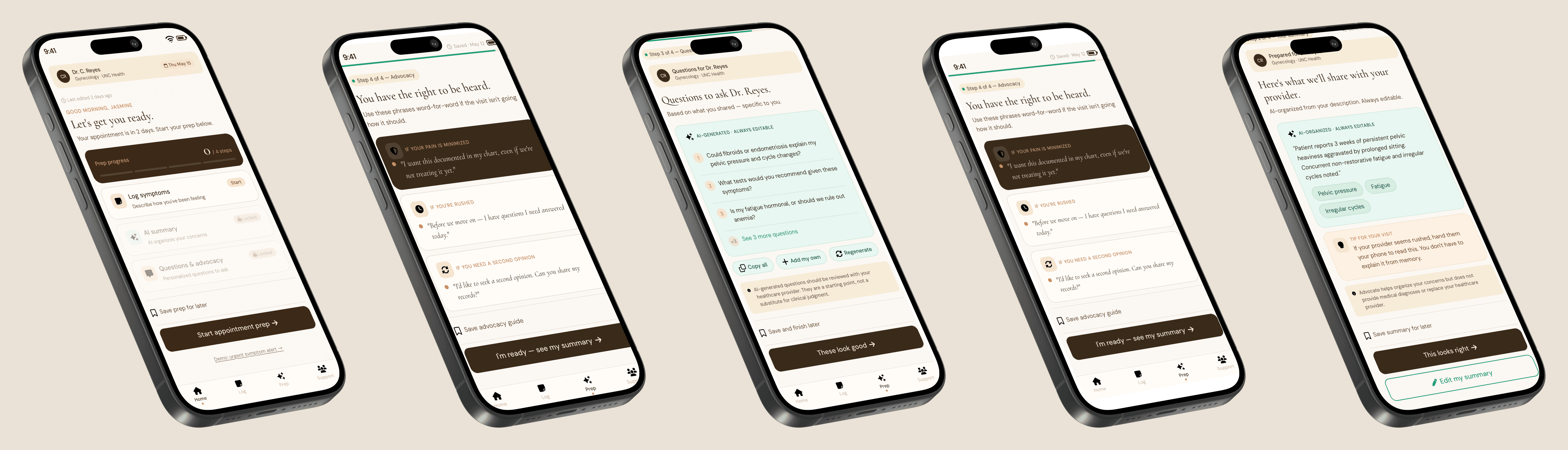
Progress Dashboard
Many participants described feeling overwhelmed before appointments, unsure where to begin preparing. To reduce this cognitive load, I designed a dashboard that breaks preparation into manageable steps, helping users organize information and track their progress before each visit.

AI Appointment Summary
Medical terminology and rushed appointments often leave patients uncertain about what was discussed. The AI-generated summary translates complex information into clear, plain language, making it easier for users to review recommendations, remember next steps, and revisit important details after their appointment.

Personalized Questions
Participants wanted help knowing what questions to ask during appointments. This feature generates personalized prompts based on the user’s symptoms and concerns, helping them communicate more effectively and advocate for their healthcare needs.

Advocacy Script
Many users expressed difficulty speaking up during appointments, especially when discussing sensitive concerns. The advocacy script provides supportive, natural language that users can reference during conversations, reducing anxiety and helping them express their needs with greater confidence.

Designing AI for Trust
One of the biggest design challenges was ensuring the AI felt supportive without appearing to replace a healthcare provider. Throughout the interface, the AI was framed as an organizational and communication tool rather than a source of medical advice. Clear language, transparent messaging, and plain-language summaries helped reinforce trust while setting appropriate expectations.
Support, don’t diagnose.
AI assists users without replacing clinical expertise.
Reduce cognitive load.
Break complex healthcare tasks into manageable steps.
Build trust through transparency.
Use plain language and clearly communicate AI’s role.
Empower self-advocacy.
Give users the tools and language to communicate confidently.
Validation & Insights
How Feedback Shaped the Design
Evaluating the concept through feedback
After developing the prototype, I gathered feedback to understand how users perceived the experience, the role of AI, and the features that felt most valuable. Rather than validating technical functionality, this phase focused on measuring trust, clarity, and whether the solution effectively supported appointment preparation.
Key Insights
AI should support (not replace) healthcare providers.
Participants responded most positively when the AI acted as an organizer and communication aid rather than a diagnostic tool. Framing the AI as a supportive companion increased trust and set appropriate expectations
Advocacy tools created the greatest impact.
Features that helped users organize their thoughts and communicate with providers resonated more strongly than AI-generated health information alone. Participants valued tools that made them feel heard and better prepared for appointments.
Tone influences trust.
Users preferred supportive, conversational language over responses that felt overly clinical or authoritative. Small adjustments in wording helped the experience feel more approachable and trustworthy.
How Feedback Shaped the Design
Feedback
Design Improvement
Users wanted AI to organize, not diagnose.
Positioned AI as a preparation and advocacy tool with clear limitations.
Clinical language felt intimidating.
Rewrote content using plain language and a more supportive tone.
Participants wanted more control over AI output.
Added editable summaries and customizable question prompts.
Key Takeaways
AI is most effective when it empowers users rather than replacing clinical expertise.
Clear communication and transparency are essential for building trust in healthcare experiences.
Supporting patient advocacy can be just as valuable as delivering information.
Reflection
Designing for trust, not just functionality
This project reinforced that designing for healthcare requires more than solving functional problems, it requires building trust. While AI has the potential to improve how people prepare for medical appointments, participants made it clear that they wanted support, not replacement. The most valuable features were those that helped users organize their thoughts, ask better questions, and feel more confident advocating for themselves.
The experience also highlighted the importance of defining clear boundaries for AI. Transparent communication, plain language, and positioning AI as a companion rather than a decision maker were essential to creating an experience users felt comfortable relying on.
Next Steps
Given more time, I would continue developing the concept by:
Conduct moderated usability testing with Black women to validate the experience with the intended audience.
Partner with healthcare professionals to refine medical content and ensure clinical accuracy.
Explore personalization features that adapt preparation based on appointment type or health history.
Expand accessibility through multilingual support and improved assistive technology compatibility.


