Google Certificate Course
2025
ITrac
A real-time bus tracking app, designed around parent and rider uncertainty and validated with 30 participants (15 transit riders, 15 parents/guardians).

Overview
Building confidence into the school commute
Parents and students often have limited visibility into the school bus journey, creating uncertainty around arrival times, delays, and safety. ITrac is a real-time bus tracking app designed to reduce that uncertainty by providing live location updates, arrival notifications, and clear route information. Through user research, iterative prototyping, and usability testing with 30 participants, I designed a solution that improved users' confidence while successfully supporting key transit tasks.
The Outcome
97%
Task success rate locating a bus
2.47 → 4.10 / 5
Confidence increased
30 participants
Validated from
Problem
The Challenge
School transportation can be unpredictable, leaving parents uncertain about their child's location and arrival while students struggle to access clear, real-time transit information. Existing solutions often prioritize location tracking without addressing the reassurance families need throughout the commute.
The challenge was to design a mobile experience that transformed real-time transit data into meaningful, easy-to-understand updates that reduced uncertainty and built confidence for both parents and students.
Project Objectives
Defining Success
🎯 Project Goals | 👥 User Goals |
|---|---|
Design an intuitive transit experience. | Track the bus in real time. |
Reduce uncertainty during the commute. | Receive timely notifications. |
Prioritize accessibility and clarity. | Access information quickly. |
Validate the design through testing. | Feel confident throughout the journey. |
My Approach
How Might We?...
To create a solution grounded in real user needs, I followed a human-centered design process that prioritized research, iteration, and continuous validation. Rather than designing based on assumptions, I gathered insights from users, translated those findings into design decisions, and refined the experience through usability testing. This iterative approach ensured that each stage of the project built on real evidence and user feedback.
Process
01
🔍 Research
Understand users, identify pain points, and uncover opportunities through surveys, competitive analysis, and user research.
02
🧩 Define
Synthesize findings into key insights, design requirements, and a clear problem statement.
03
🎨 Design
Develop user flows, wireframes, and high-fidelity prototypes, iterating on solutions based on feedback.
04
✅ Validate
Conduct usability testing to evaluate the design, measure success, and identify opportunities for improvement.
Research
Refining the dashboard experience
Understanding the Problem
To better understand the challenges families face during the school commute, I conducted user research to identify pain points, behaviors, and expectations surrounding school bus transportation. The goal was to uncover where existing experiences fell short and determine which features would have the greatest impact.
Research Methods
Method | Purpose |
|---|---|
📋 Survey | Gather quantitative insights about commuting habits and user frustrations. |
🔍 Competitive Analysis | Evaluate existing transit apps to identify strengths, weaknesses, and opportunities. |
👤 Persona Development | Synthesize research into representative user needs and motivations. |
🗺️ Journey Mapping | Visualize the school commute to uncover moments of uncertainty and friction. |
Key Research Insights
❤️ Families value reassurance over tracking.
Participants wanted more than a live map, they wanted confidence that the bus was on schedule and that students arrived safely.
🔔 Timely communication reduces uncertainty.
Users expected proactive updates about delays, arrivals, and route changes rather than having to constantly check the app.
👥 Parents and students have different priorities.
Parents focused on safety and notifications, while students wanted a simple, fast way to view their route and arrival time.
⚠️ Existing solutions don’t fully address school transportation.
Most transit apps were designed for public transportation, leaving gaps in the communication and reassurance families need during the school commute.
Persona

Competitive Analysis

Design
From Insights to Solutions
Research revealed that families needed more than a tracking app, they needed confidence throughout the school commute. Guided by these insights, I designed an experience that prioritized visibility, timely communication, and ease of use for both parents and students.
📍
Real-Time Bus Tracking
One of the primary goals was to help users quickly understand where the bus was and when it would arrive. A live map with clear location indicators and estimated arrival times gave families immediate visibility into the commute.

👥
Separate Experiences for Parents and Students
Research showed that parents and students had different priorities. Parents needed reassurance and detailed updates, while students valued a simple interface focused on route information and arrival times.
Designing separate experiences allowed each user group to access the information most relevant to their needs.

♿
Accessible & Intuitive Interface
The interface was designed with clarity and accessibility in mind. Clear navigation, consistent visual hierarchy, and high-contrast elements made essential information easy to find at a glance, even during busy moments.
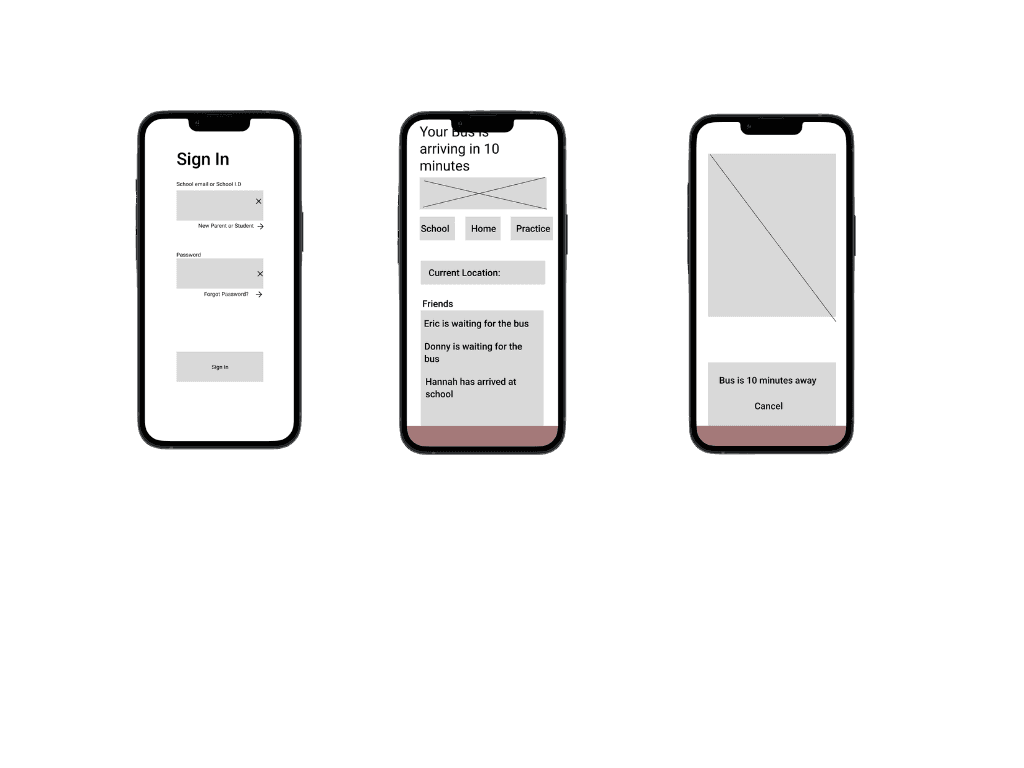
Design Evolution
Iterations
User feedback revealed that some navigation labels and information hierarchy were unclear. Based on these findings, I simplified the layout, improved labeling, and made key actions more prominent.
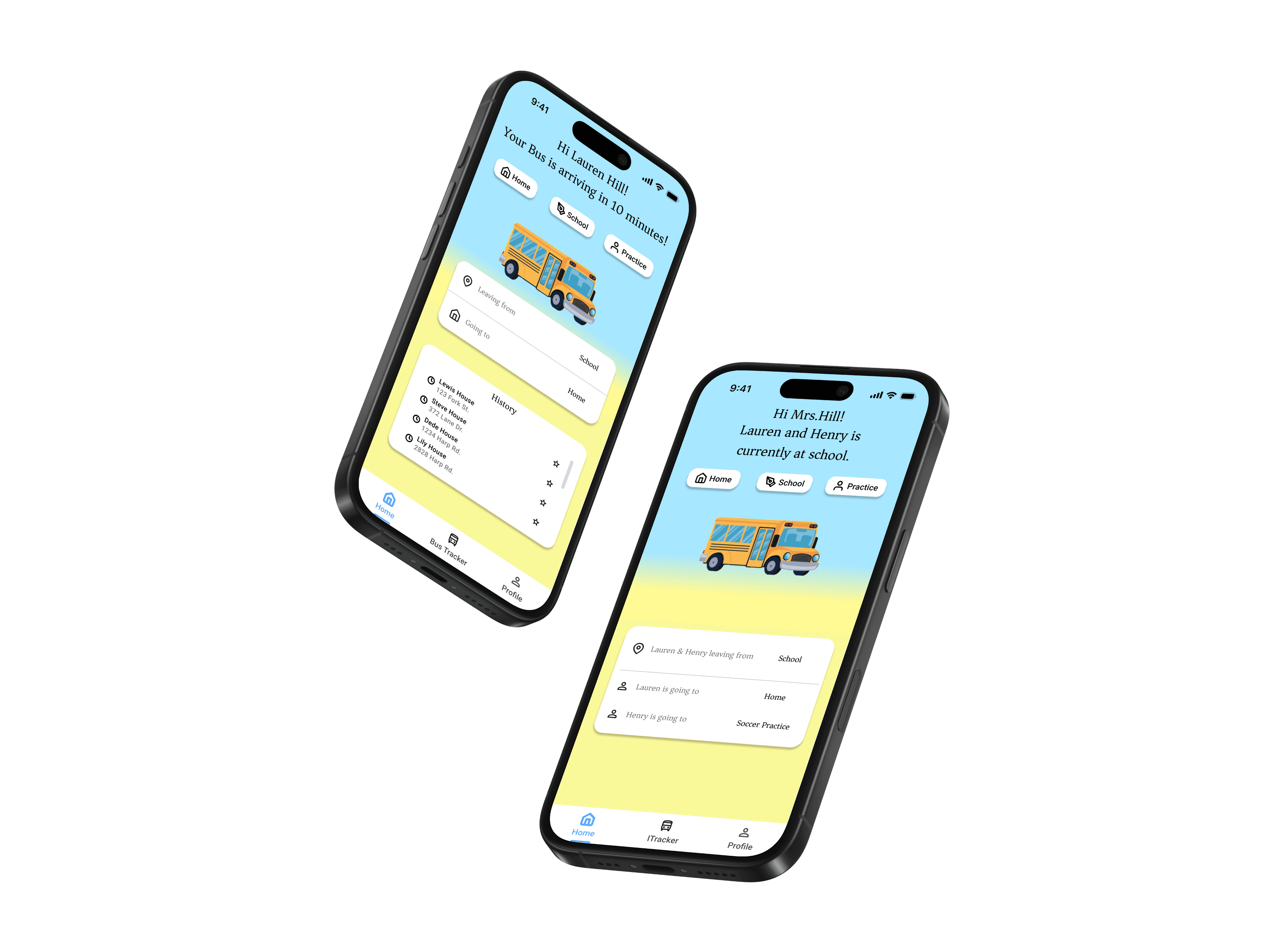
Final Design
Present the refined interface and explain how the changes improved the overall user experience.

Usability Testing & Iteration
Validating the Design
To evaluate the effectiveness of the prototype, I conducted moderated usability testing with 30 participants. The sessions focused on measuring how easily users could complete key tasks, identify areas of confusion, and understand whether the experience increased confidence during the school commute.
Testing Goals
Evaluate the ease of completing core tasks. Identify usability issues and areas for improvement. Measure user confidence before and after using the prototype. Gather qualitative feedback to guide design refinements.
Key Findings
97% Task Success
Participants were able to successfully locate a school bus, view route information, and navigate the prototype with minimal difficulty.
Confidence Increased
Users' confidence in tracking the school commute increased from 2.47 to 4.10 out of 5, demonstrating that clear communication and real-time updates helped reduce uncertainty.
Design Improvements
Feedback | Design Change |
|---|---|
🔔 Some users overlooked important notifications. | Increased the prominence of notifications and improved visual hierarchy. |
▦ Route information was difficult to scan. | Simplified the layout and improved information grouping. |
🏷️ Navigation labels caused confusion. | Updated labels to use clearer, more familiar language. |
Iteration Reflection
Usability testing confirmed that reducing uncertainty required more than providing location data, it required presenting information in a way that felt timely, clear, and reassuring. Iterating on the design based on user feedback strengthened both the usability of the interface and users’ confidence in the overall experience.
Reflection
📈 97% Task Success
30 Participants
2.47 → 4.10 Confidence Score
Validated with user testing
Separate parent and student experiences
Research-informed design decisions
Reflection
Designing ITrac reinforced that great user experiences are built on understanding people, not just solving technical problems. Throughout the project, research consistently showed that families weren’t simply looking for a way to track a bus, they were looking for confidence and reassurance during the school commute.
Usability testing validated that prioritizing clear communication, intuitive navigation, and timely updates helped users complete tasks successfully while increasing their confidence in the experience. The iterative design process also highlighted the importance of testing early and often, allowing feedback to shape meaningful improvements before the final prototype.
Next Steps
If this project continued, I would focus on expanding the experience by:
Integrating live GPS data for real-time bus tracking.
Designing features for school administrators and bus drivers.
Improving accessibility through multilingual support and enhanced screen reader compatibility.
Conducting longitudinal testing to evaluate how the app performs during daily use.
Key Takeaways
✅ Research drives better decisions. Understanding user needs led to more meaningful design solutions.
✅ Iteration improves outcomes. Continuous testing helped refine the experience and increase usability.
✅ Confidence is part of the user experience. Clear, proactive communication proved just as valuable as real-time tracking.


